Showing posts with label history. Show all posts

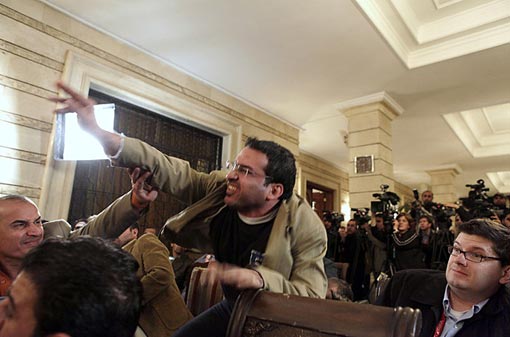
Why I Threw the Shoe?

Why I Threw the Shoe?

"I am no hero. I just acted as an Iraqi who witnessed the pain and bloodshed of too many innocents"
By Muntazer al-Zaidi


September 19, 2009 "The Guardian" -- I am free. But my country is still a prisoner of war. There has been a lot of talk about the action and about the person who took it, and about the hero and the heroic act, and the symbol and the symbolic act. But, simply, I answer: what compelled me to act is the injustice that befell my people, and how the occupation wanted to humiliate my homeland by putting it under its boot.
Over recent years, more than a million martyrs have fallen by the bullets of the occupation and Iraq is now filled with more than five million orphans, a million widows and hundreds of thousands of maimed. Many millions are homeless inside and outside the country.

We used to be a nation in which the Arab would share with the Turkman and the Kurd and the Assyrian and the Sabean and the Yazid his daily bread. And the Shia would pray with the Sunni in one line. And the Muslim would celebrate with the Christian the birthday of Christ. This despite the fact that we shared hunger under sanctions for more than a decade.

Our patience and our solidarity did not make us forget the oppression. But the invasion divided brother from brother, neighbour from neighbour. It turned our homes into funeral tents.

I am not a hero. But I have a point of view. I have a stance. It humiliated me to see my country humiliated; and to see my Baghdad burned, my people killed. Thousands of tragic pictures remained in my head, pushing me towards the path of confrontation. The scandal of Abu Ghraib.

The massacre of Falluja, Najaf, Haditha, Sadr City, Basra, Diyala, Mosul, Tal Afar, and every inch of our wounded land. I travelled through my burning land and saw with my own eyes the pain of the victims, and heard with my own ears the screams of the orphans and the bereaved. And a feeling of shame haunted me like an ugly name because I was powerless.

As soon as I finished my professional duties in reporting the daily tragedies, while I washed away the remains of the debris of the ruined Iraqi houses, or the blood that stained my clothes, I would clench my teeth and make a pledge to our victims, a pledge of vengeance.

The opportunity came, and I took it.

I took it out of loyalty to every drop of innocent blood that has been shed through the occupation or because of it, every scream of a bereaved mother, every moan of an orphan, the sorrow of a rape victim, the teardrop of an orphan.

I say to those who reproach me: do you know how many broken homes that shoe which I threw had entered? How many times it had trodden over the blood of innocent victims? Maybe that shoe was the appropriate response when all values were violated.

When I threw the shoe in the face of the criminal, George Bush, I wanted to express my rejection of his lies, his occupation of my country, my rejection of his killing my people. My rejection of his plundering the wealth of my country, and destroying its infrastructure. And casting out its sons into a diaspora.

If I have wronged journalism without intention, because of the professional embarrassment I caused the establishment, I apologise. All that I meant to do was express with a living conscience the feelings of a citizen who sees his homeland desecrated every day. The professionalism mourned by some under the auspices of the occupation should not have a voice louder than the voice of patriotism. And if patriotism needs to speak out, then professionalism should be allied with it.

I didn't do this so my name would enter history or for material gains. All I wanted was to defend my country.


Umar and Amr: ISA, freedom of speech, corruption & immunity

Umar bin al-Khattab (r.a.) was the second caliph, succeeding Abu Bakr as-Siddiq (r.a). He was well-known for his soft yet rigid heart.

Amr bin al-Aas was the conqueror and governor of Egypt. He enjoyed a high position but in spite of that he did not escape from the scrutiny of Umar.


Story #1:
It was reported to Umar that Amr had amassed much wealth. Umar wrote to Amr:

"It has come to my notice that you have amassed considerable wealth. Originally you were a man of ordinary means. Whence comes such wealth?"

Amr explained that he owned some land which brought good income. Moreover the salary that he got was ample which he could invest in business.

Umar was not satisfied with the explanation. He had half of the wealth of Amr confiscated to the State. Umar reprimanded Amr in the following terms:

"O ye Governors you have sat on the springs of wealth. Nothing stands in your way in amassing wealth. You people are playing with fire."


Story #2:
Amr bin Al Aas had a pulpit for himself in the Juma Mosque at Fustat. Umar rebuked Amr for that in the following terms:

"I cannot approve that the Muslims should sit low while you should sit above them. Do away with the pulpit."

Amr bin Al Aas complied with the orders.


Story #3:
Once on the occasion of the Hajj in the presence of all the Governors, Umar addressed the people:

"O ye people, I have not sent the Governors so that they may maltreat you or deprive you of your lawful possessions. I have sent them so that they may be a source of inspiration to you in leading life according to the Islamic way. If any Governor violates these terms, please inform me and would take action."

A man rose up from the congregation to inquire whether a Governor could on his own account beat a Muslim. Umar said that if any punishment was inflicted as a result of a judicial trial the man could be punished; otherwise not. The man complained that Amr bin Al Aas the Governor of Egypt had inflicted eighty stripes on him without any judicial trial. Amr said that he had beaten the man to enforce discipline Umar said that unless the man was judicially tried and found guilty no punishment could be inflicted on him. Umar asked the complainant that as Amr beat him without authority, he could strike him with a similar number of lashes to vindicate himself. Amr begged for Umar's permission to conciliate the man. Umar agreed, and Amr bin Al Aas conciliated the man after paying him a substantial amount.


Story #4:
On one occasion Amr called a man 'Munafiq'. The man came to Umar and complained. Umar gave the complainant the authority to return to Egypt, confront the Governor with the charge before the public and if it was established claim indemnity. The man returned to Egypt and confronted the Governor with the charge in the main mosque. Amr denied the charge but the man asked the men in the congregation to say on oath whether they had heard the Governor on such and such a day calling him 'Munafiq'. Many persons stood up to corroborate the statement. Thus cornered Amr said to the complainant, "You may take your revenge". Thereupon the complainant said, "Now I forgive you."


Story #5:
On another occasion an Egyptian complained before Umar that in a horse race his horse was leading but Muhammad the son of Amr beat him and had his own horse to be the winner. When the matter was brought to the notice of Amr he put the complainant in prison. The complainant escaped from the prison and came to Madina to lodge his complaint with Umar. Umar summoned Amr and his son to Madina. They were apprised of the complaint against them. They could not offer a satisfactory explanation. Umar ordered that the complainant should beat Muhammad the son of Amr in the same way as Muhammad had beat him. The complainant beat Muhammad the son of Amr accordingly and felt satisfied.


Umar al-Khattab had shown us a good example of how a leader should be. Leaders should not get themselves busy accumulating wealth, especially through corruption. Should not be oppressing the people of their freedom of speech. Should not think themselves as immune from the law. And should never ever punish anyone without a fair trial. Think of Umar al-Khattab, and then think about our leaders. Do you see any differences? I do...


-Ariff Abdullah